
Spacecraft Design Workshop For Professionals
A hands-on, four-day workshop for the growing space economy — taking you from mission requirements to spacecraft architecture, model-based design, and validation-ready decisions. Build technical fluency and connect with the professionals shaping the future of space.

-
 dATE
dATE13 to 16 October 2026
-
time
9:00 AM - 5:00 PM
-
VENUE
Singapore
-
FEES
SGD2,499
-
Certificate of Completion
 dATE
dATE time
time VENUE
VENUE FEES
FEESCourse Information
From mission requirements to validation-ready architecture, this four-day, in-person workshop provides a practical introduction to model-based systems engineering and its application to modern space missions. Work hands-on with CATIA Magic with SysML v2 — the modelling standard now adopted by agencies including NASA and ESA. Learn how model-based approaches can help teams structure requirements, explore design options, manage system complexity, and make better-informed engineering trade-offs.
You will also learn to treat a satellite mission as one connected system — bringing the payload, spacecraft, ground segment, and orbit into alignment from the initial mission requirements through to architecture and design decisions.
Beyond gaining technical literacy, the workshop provides an opportunity to meet and connect with professionals across the space sector, exchange perspectives, and build relationships with others working in spacecraft design, engineering, and the wider space ecosystem.
Who should attend? Professionals in the space and space-adjacent sectors, suppliers to the space sector who need to speak their customers’ mission language, or anyone looking to get started in space. No prior experience is needed.

Mission-As-A-System Thinking
Manage the end-to-end enterprise: payload, ground segment, and orbit in alignment.
Model-Based Design In SysML v2
The emerging standard adopted by NASA and ESA, modelled live in CATIA Magic.
Oversight, Risk & Vendor Communication
Evaluate trade-offs, manage cross-team risk, and coordinate with suppliers and leads.
Continuous Digital Validation
Digital twins, automated simulation, and validation pipelines that shorten cycles.
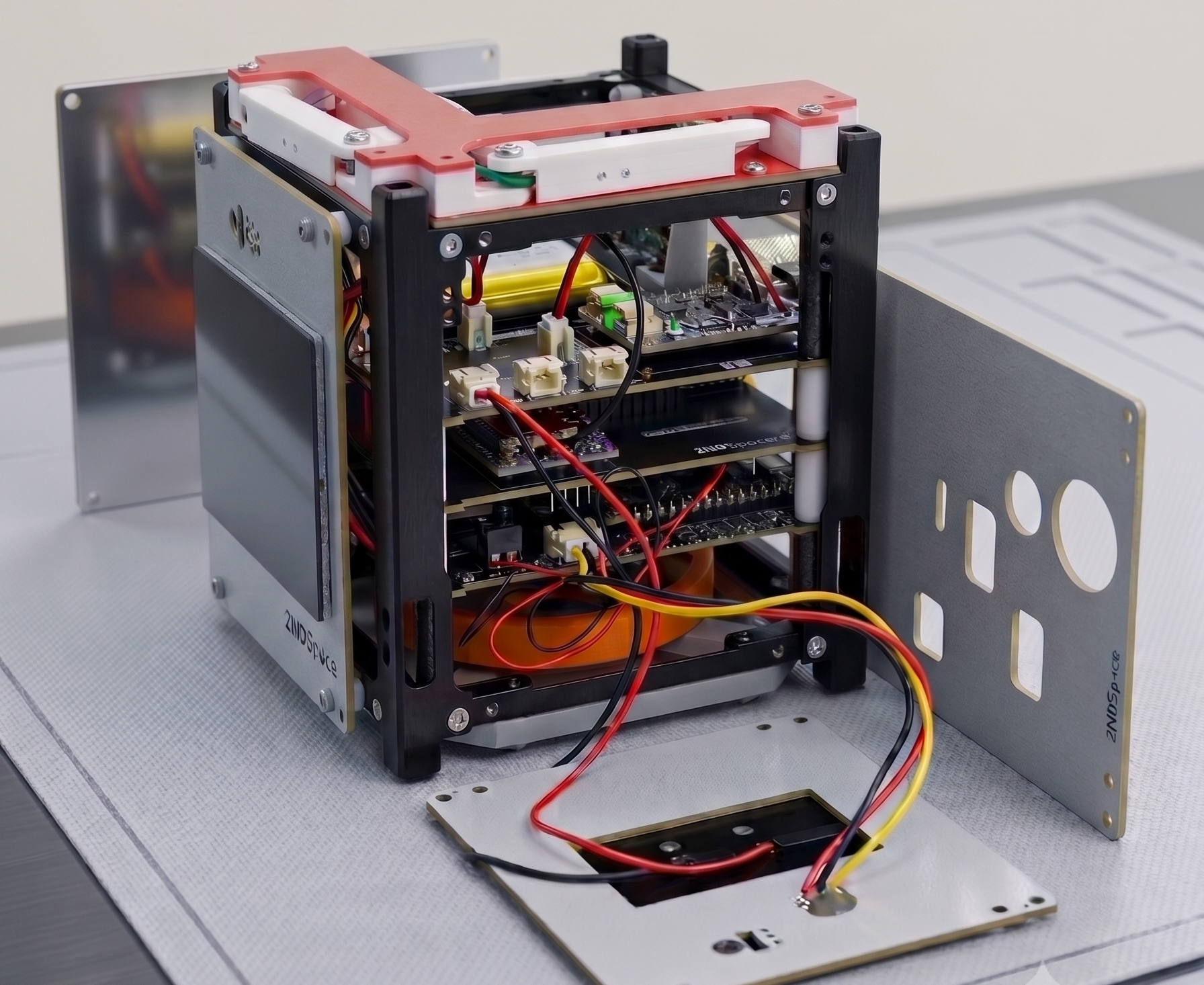
Hands-On: Build A 1U CubeSat
Assemble and understand a real small-satellite platform.